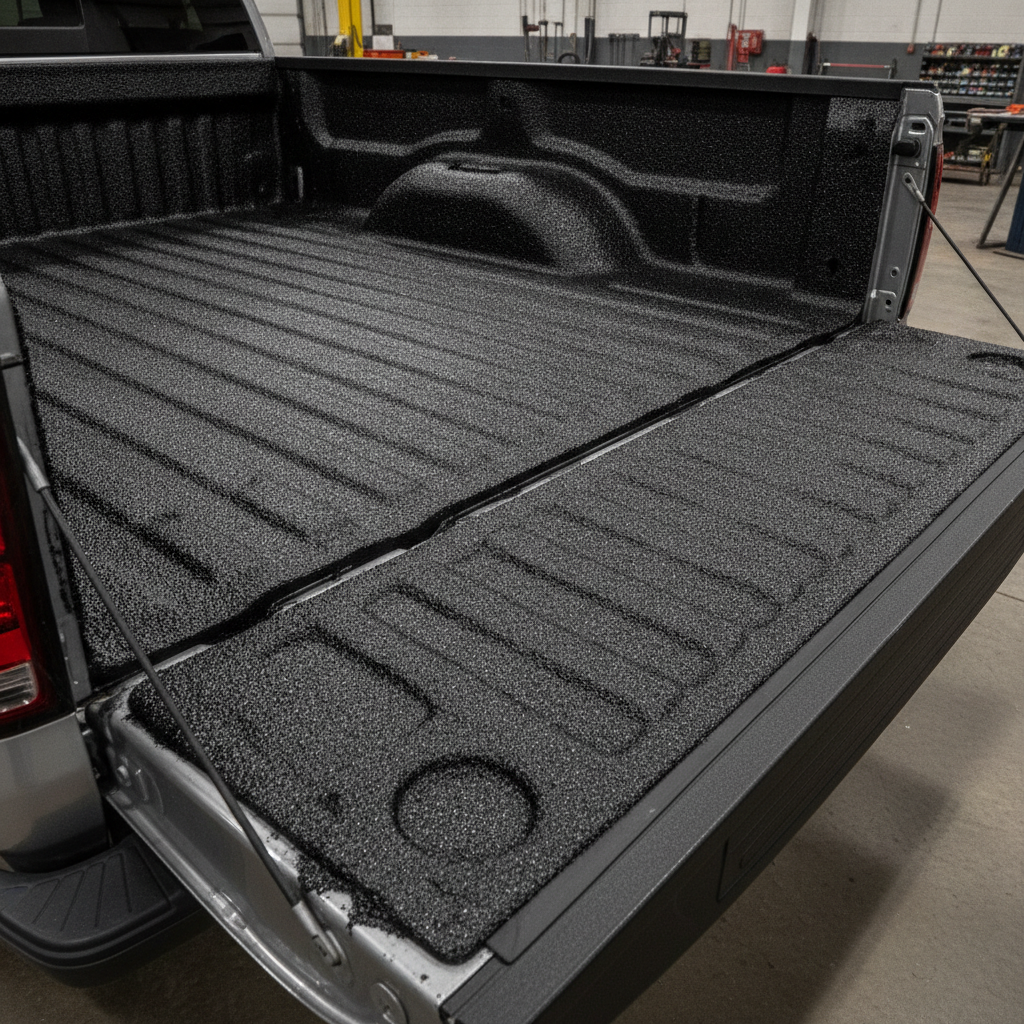
You can run a clean shop, train your techs well, and still have a coating fail months after the truck left your bay. Spray-on bedliner and protective coating work is unforgiving — the difference between a bond that lasts a decade and one that peels in a season often comes down to a few degrees of surface temperature or a percentage point in mix ratio. When a coating fails, the question is no longer whether you did good work; it is whether you are protected when a customer says you did not. That protection lives in a coverage most owners overlook: products-completed operations.
Why Coatings Fail
Even experienced applicators see failures, because so many variables have to line up. The most common modes include:
- Delamination and adhesion failure. The coating lifts away from the substrate. This usually traces back to surface prep — inadequate sanding or profiling, contamination from oil, wax, or dust, or skipping a recommended adhesion promoter.
- Peeling and flaking. Often a downstream symptom of poor adhesion, but also caused by applying over a surface that was not fully clean or dry.
- Blistering and bubbling. Moisture trapped under the coating, application in high humidity, or spraying over a damp surface can cause blisters as the coating cures.
- Soft spots or improper cure. Off mix ratios, expired or improperly stored material, or spraying outside the product's temperature window can leave a coating that never cures correctly.
- Texture and thickness defects. Equipment problems, pressure issues, or inconsistent technique that leave thin spots vulnerable to wear-through.
The point is not that these failures mean negligence. The point is that they happen, customers notice, and some of them will demand more than a redo.
Workmanship Warranty Is Not the Same as Liability Coverage
Most reputable bedliner shops back their work with a workmanship warranty — a promise to repair or redo a coating that fails. That is good business, and customers expect it. But a warranty and insurance are two very different things, and conflating them leaves shops exposed.
A workmanship warranty is a contractual obligation you fund out of your own pocket. If a coating delaminates, your warranty says you will strip and respray it. The cost of that redo — your labor, your material, your time — is generally not an insurable loss. Insurance does not pay you to fix your own work. That is a cost of doing business, and it is exactly what your warranty is for.
What insurance addresses is something different and often far more expensive: the damage that the failure causes to other things, and the cost of defending yourself when a customer or third party makes a claim. That is the job of products-completed operations coverage.
What Completed-Operations Coverage Actually Covers
Products-completed operations is a component of general liability that responds to bodily injury or property damage arising out of your finished work after you have left the job — after the truck has driven away.
For a coating shop, the meaningful scenarios are not the redo itself, but the consequences:
- Resulting damage. A coating fails, lets moisture reach the bed, and the truck bed rusts or corrodes, or cargo carried on a failed liner is damaged. Completed-operations coverage can respond to that resulting damage, even though it will not pay to respray your own liner.
- Bodily injury. A failed or improperly cured coating that contributes to someone being hurt — a slick surface, or a piece of coating that separates and causes an injury.
- Legal defense. This is often the part owners underestimate. Even a claim that goes nowhere costs money to defend. Completed-operations coverage funds your legal defense against covered claims, which can be worth more than the settlement itself.
In other words, your warranty handles the redo; completed operations handles the fallout and the fight.
Why the Completed-Operations Aggregate Matters
Here is a detail that does not get enough attention. General liability policies carry separate aggregate limits, and products-completed operations typically has its own aggregate — the most the policy will pay for all completed-operations claims during the policy term.
This matters for coating shops because of how failures behave. A coating problem is rarely a one-off. If a batch of material was bad, a piece of equipment was out of spec, or a procedure drifted over a stretch of jobs, you could see multiple failures from the same root cause around the same time. Each is a potential claim, and they all draw down the same completed-operations aggregate.
So when you evaluate your policy, do not look only at the per-occurrence limit. Look at the completed-operations aggregate and ask whether it is high enough to absorb a cluster of claims, not just one. A limit that looks generous for a single failure can be inadequate if several land in the same year.
The Related Gap: Pollution and Isocyanate Overspray
There is one more exposure that sits next to completed operations and is frequently uncovered: pollution liability.
Polyurethane and polyurea coatings rely on isocyanates. During spraying, isocyanate overspray and the associated fumes are a recognized health and environmental concern. Standard general liability policies generally contain a pollution exclusion that can apply to claims arising from these materials — meaning a bodily injury or cleanup claim tied to isocyanate overspray could fall outside your GL coverage entirely.
For a shop spraying these products day in and day out, a pollution liability policy or endorsement is worth serious consideration. It is designed to respond where the pollution exclusion shuts your general liability down, closing a gap that is easy to miss until a claim exposes it.
Make Sure Your Finished Work Is Actually Covered
A solid workmanship warranty keeps your customers happy. Products-completed operations coverage — with an aggregate sized for the way coating failures cluster — keeps a single bad batch or a disputed claim from threatening the business. And pollution liability addresses the isocyanate exposure that your GL may quietly exclude. Together, they protect the work after it leaves your shop, which is exactly when you have the least control over it.
Bedliner Insurance, a division of Contractors Choice Agency, has specialized in coverage for spray-on bedliner and protective coating shops since 2005. We are licensed in all 50 states and place coverage with A.M. Best A+ rated carriers.
If you are not sure whether your policy carries adequate products-completed operations coverage — or whether your isocyanate exposure is addressed — let us review it. Call 844-967-5247 or request a quote today, and we will make sure your finished work is protected long after the truck drives off your lot.