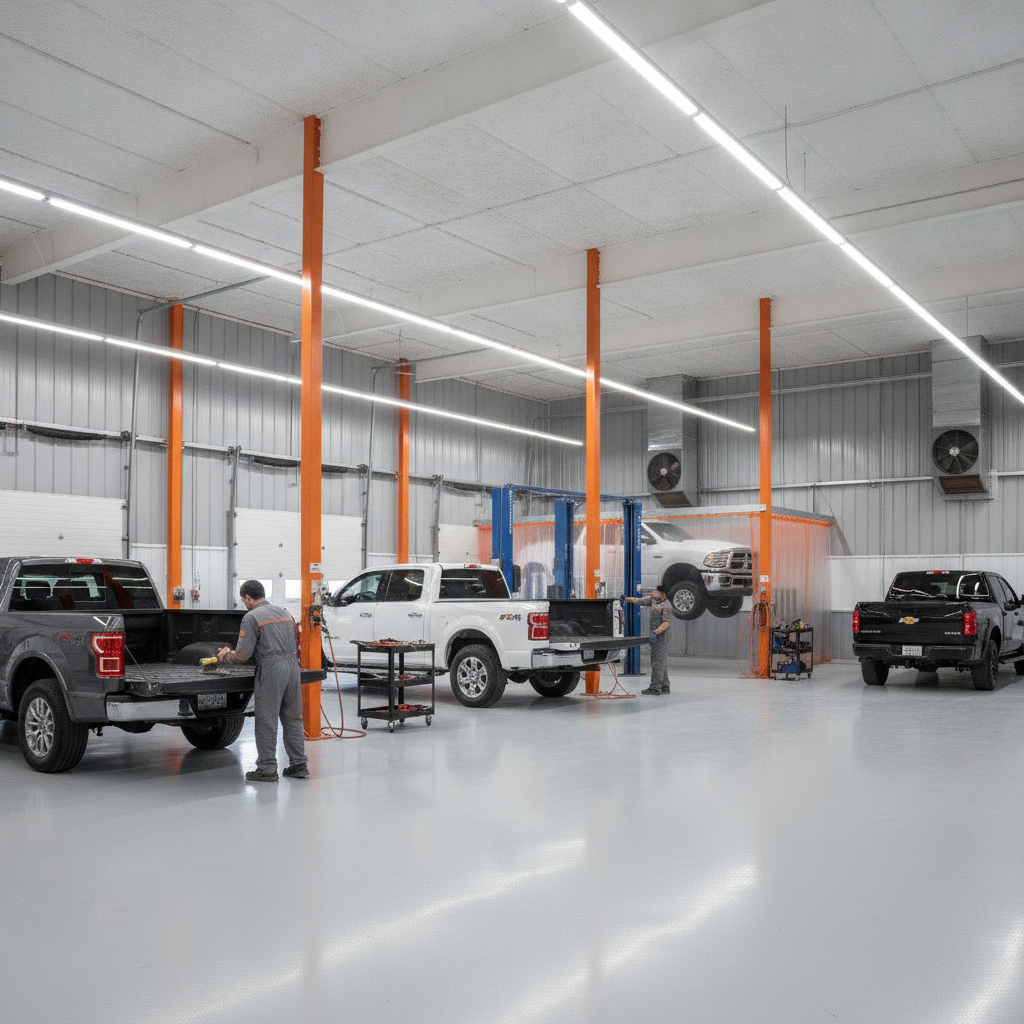
Few insurance terms cause more confusion among bedliner and coating shop owners than garage liability and garagekeepers. They sound nearly identical, they both show up on automotive-service policies, and they are routinely mixed up — even by people who should know better. But they cover entirely different things, and assuming one when you actually need the other can leave a painful gap. Here is how to tell them apart and decide what your shop needs.
The Short Version
- Garage liability protects you when your operations injure someone else or damage someone else's property — third parties.
- Garagekeepers protects the customer vehicles in your care when they are physically damaged — your customers' property.
One faces outward to the world. The other faces the trucks parked in your bay. Most coating shops need both, because the risks they cover are real and largely non-overlapping.
What Garage Liability Covers
Garage liability is the automotive-trade version of general liability, tailored for businesses that work on or around vehicles. It responds to third-party bodily injury and property damage that arise out of your garage operations.
For a spray-on bedliner shop, that looks like:
- A customer slips on overspray residue or a wet floor in your waiting area and is injured.
- Your sign or signage falls and damages a parked car or a passerby's property.
- A test drive or vehicle movement causes you to back into another person's vehicle or property that is not in your custody.
- Premises hazards — a visitor trips over an air hose, an unsecured rack tips over, a delivery driver is hurt on your lot.
Garage liability typically also extends to products and completed operations in some forms, meaning it can respond if your finished coating work leads to third-party injury or damage after the customer leaves. The common thread is that someone other than you suffers harm and looks to you to pay.
What garage liability does not cover is damage to the customer's own vehicle while it is in your hands. That is specifically excluded — and it is exactly where garagekeepers comes in.
What Garagekeepers Covers
Garagekeepers covers physical damage to a customer's vehicle while it is in your care, custody, or control. From the moment a customer leaves their truck with you until they drive away, you are responsible for it, and garagekeepers is the policy built for that responsibility.
For a coating shop, the typical garagekeepers claims are:
- Overspray that drifts onto paint, glass, trim, or wheels and requires correction or repainting.
- Fire in the shop that damages or destroys vehicles in your custody.
- Theft of a vehicle, or parts and accessories, from your lot.
- Collision or movement damage while repositioning a customer truck in your bays or yard.
- Weather and vandalism — hail, falling objects, keying, broken glass.
Garagekeepers comes in different forms. A legal liability form pays only when you are proven at fault. A direct primary form pays for covered damage regardless of fault, up to your limit, which lets you make customers whole quickly and protect your reputation. Many coating shops choose a direct primary form for exactly that reason.
Why the Distinction Trips People Up
The confusion is understandable. Both coverages live on the same family of automotive policies. Both involve vehicles. Both involve damage. But the legal mechanics are opposite.
Garage liability is about harm your business causes to others. Garagekeepers is about harm that befalls property you are temporarily holding for someone else.
The reason this matters so much is the care, custody, or control exclusion. Standard liability policies — including garage liability — exclude damage to property that is in your care, custody, or control. Since every customer vehicle on your lot is, by definition, in your care, your liability coverage will not pay to fix it. Only garagekeepers fills that gap. So if you carry garage liability but skip garagekeepers, an overspray claim on a customer's new truck could land entirely on you.
Why a Bedliner Shop Typically Needs Both
A spray-on bedliner or protective coating shop generates both kinds of risk every single day, which is why a complete program usually carries both coverages.
Consider a normal week. You have customers walking through your lobby and across your lot — that is garage liability exposure. At the same time, you have customer trucks in your bays being masked, prepped, and sprayed — that is garagekeepers exposure. A slip-and-fall is a garage liability claim. An overspray ruin is a garagekeepers claim. Carrying only one leaves the other entirely uncovered.
There are also exposures neither of these covers, which is why coating shops usually round out their program with:
- General liability for broader premises and operations risk.
- Commercial property for your building, equipment, spray rigs, and inventory.
- Workers' compensation for employee injuries, including respiratory and chemical-handling risks specific to isocyanate-based coatings.
- Commercial auto if you run mobile or on-site application.
- Products-completed operations for coating failures that cause damage after the job is done.
The point is that no single policy is "the" coating shop policy. The right answer is a coordinated program where garage liability and garagekeepers each handle their own slice of your risk.
Building the Right Program for Your Shop
Whether you are a fixed-location franchise applicator or an independent mobile polyurethane and polyurea coater, the mix of limits and forms should match how you actually operate. A high-volume shop that handles new diesel trucks needs different garagekeepers limits than a small operation working on older work vehicles. A mobile applicator needs coverage that follows the vehicle to a job site, not just a fixed bay.
Bedliner Insurance, a division of Contractors Choice Agency, has focused on coverage for spray-on bedliner and protective coating shops since 2005. We are licensed in all 50 states and place business with A.M. Best A+ rated carriers, so your program is backed by financially strong insurers.
If you are not sure whether you currently carry garage liability, garagekeepers, or both — and whether your limits match your real exposure — let us take a look. Call 844-967-5247 or request a quote today, and we will help you build coverage that fits the way your shop actually runs.